
ISTQB CTFL v4.0 - Certified Tester Foundation Level (CTFL) v4.0 Exam
Page: 4 / 5
Total 202 questions
Question #151 (Topic: Exam A)
Which ONE of the following statements would you expect to be the MOST DIRECT advantage of the whole-team approach?
A. Capitalizing on the combined skills of business representatives, testers, and developers working together to contribute to project success.
B. Reducing the involvement of business representatives because of enhanced communication and collaboration between testers and developers.
C. Avoiding requirements misunderstandings that may not have been detected until dynamic testing when they are more expensive to fix.
D. Having an automated build and test process, at least once a day, that detects integration errors early and quickly.
Question #152 (Topic: Exam A)
Which ONE of the following roles is responsible for mediating, managing time, and generating a safe review environment in which everyone can speak freely?
A. Manager
B. Reviewer
C. Review leader
D. Moderator
Question #153 (Topic: Exam A)
Which ONE of the following elements is TYPICALLY used to guide testing during exploratory testing?
A. A test charter that defines the testing objectives for the test session.
B. A comprehensive specification that must be fully available before testing begins.
C. A detailed test script that prescribes all the steps to be performed.
D. A predefined test case that must be executed exactly as documented.
Question #154 (Topic: Exam A)
Which ONE of the following statements BEST applies checklist-based testing?
A. Checklists should contain general guidelines to ensure that all aspects of the software are covered.
B. Checklists should contain specific test conditions that can be individually and directly checked.
C. Checklists should primarily consist of automated test cases to maximize efficiency.
D. Checklists should be used exclusively for functional testing, as they are unsuitable for non-functional testing.
Question #155 (Topic: Exam A)
Which ONE of the following options corresponds to an activity in the testing process in which testable features are identified?
A. Test design
B. Test analysis
C. Test implementation
D. Test execution
Question #156 (Topic: Exam A)
Which ONE of the following options MOST ACCURATELY describes branch testing?
A. In branch testing, the coverage items are executable statements. The aim is to design test cases that exercise statements in the code until an acceptable level of coverage is achieved, expressed as a percentage.
B. In branch testing, the coverage items are control flow transfers between decisions, and the aim is to design test cases to exercise flow transfers in the code until an acceptable level of coverage is achieved. Coverage is measured as the number of branches exercised by the test cases divided by the total number of branches expressed as a percentage.
C. In branch testing, the coverage items are branches, and the aim is to design test cases to exercise branches in the code until an acceptable level of coverage is achieved. Coverage is measured as the number of branches exercised by the test cases divided by the total number of branches expressed as a percentage.
D. In branch testing, the coverage items are executable decisions. The aim is to design test cases that exercise statements in the code until an acceptable level of coverage is achieved. Coverage is expressed as a percentage.
Question #157 (Topic: Exam A)
Which ONE of the following is a GOOD testing practice that is INDEPENDENT of the chosen SDLC (Software Development Life Cycle) model?
A. Testers are involved in reviewing work products as soon as the final version of this documentation is available so that this earlier testing and defect detection can support the “shift-left” strategy.
B. Test analysis and design for a specific test level begin during the corresponding development phase of the SDLC, allowing testing to follow the principle of late testing.
C. For every software development activity, there is a corresponding testing activity, ensuring that all development activities are subject to quality assurance.
D. Different test levels have specific and overlapping test objectives, allowing tests to be appropriate to specific test object types while managing redundancy.
Question #158 (Topic: Exam A)
Which ONE of the following options is NOT a benefit of test automation?
A. Reduced test execution times
B. More objective assessment
C. Prevention of simple human errors
D. Eliminating completely the need for manual testing
Question #159 (Topic: Exam A)
Which ONE of the following elements is TYPICALLY NOT part of a test progress report?
A. Obstacles and their workarounds
B. A detailed assessment of product quality
C. Test metrics to show the current status of the test process
D. New or changed risks
Question #160 (Topic: Exam A)
Consider the following statements about acceptance test levels (I to V):
A. Statements I, III, and V
B. Statements II, IV, and V
C. Statements II and V
D. Statements I and IV
I. Acceptance test levels focus on validating and demonstrating readiness for deployment.
II. Acceptance test levels must be performed by an independent test team.
III. Acceptance test levels often require specific support, such as test harnesses.
IV. Acceptance test levels ideally should be performed by the intended users.
V. Acceptance test levels use component specifications as the test basis for the system.
Which ONE of the following options contains the statements (I - V) that MOST ACCURATELY characterize acceptance test levels?
Question #161 (Topic: Exam A)
Which ONE of the following options BEST characterizes the Behavior-Driven Development (BDD) approach?
A. Expresses the desired behavior of an application with test cases written in a simple form of natural language that is easy to understand by stakeholders — usually using the Preconditions/Input Values/Process/Output Values/Postconditions format. Test cases are then automatically translated into executable tests.
B. Expresses the desired behavior of an application with test cases written in a simple form of natural language that is easy to understand by stakeholders — usually using the Given/When/Then format. Test cases are then automatically translated into executable tests.
C. Derives tests from acceptance criteria as part of the system design process. Tests are written before the part of the application is developed to satisfy the tests. Tests will persist as automated tests to ensure code maintainability in future adaptions/refactoring.
D. Derives tests from acceptance criteria as part of the system design process. Tests are written before the part of the application is developed to satisfy the tests. Tests may persist as automated tests to ensure the code quality in future adaptions/refactoring.
Question #162 (Topic: Exam A)
Which ONE of the following elements is TYPICALLY part of the test plan?
A. The budget and schedule for the test project.
B. A detailed analysis of the defects found and their causes.
C. A detailed report on the test results after the test project is completed.
D. A list of test logs from the test execution.
Question #163 (Topic: Exam A)
Which ONE of the following options identifies the perspectives through which a collective authorship process generates a shared vision of user stories?
A. Product owner, development, and testing
B. Business, architecture, and testing
C. Business, development, and testing
D. Business, development, and acceptance testing
Question #164 (Topic: Exam A)
Which ONE of the following options BEST describes the third test quadrant (3)?
A. This test quadrant contains smoke tests and non-functional tests (except usability tests). These tests are often automated.
B. This test quadrant is business-facing and criticizes the system. It contains exploratory testing, usability testing, and user acceptance testing.
C. This test quadrant contains functional tests, examples, user story tests, user experience prototypes, API testing, and simulations. These tests check the acceptance criteria and can be manual or automated.
D. This test quadrant is technology-facing and supports the team. These tests should be automated and included in the continuous integration (CI) process.
Question #165 (Topic: Exam A)
Which ONE of the following options BEST describes black-box test techniques?
A. Black-Box testing techniques are based on experience with the test object without knowing the internal structure.
B. In Black-Box testing techniques, test cases are created based on the software's implementation.
C. Black-box testing techniques are based on analyzing the test object's specified and implied behavior without knowledge of its internal data structure.
D. Black-box testing techniques involve analyzing the specified behavior of the test object without knowledge of its internal structure.
Question #166 (Topic: Exam A)
Which of the following is a typical test objective?
A. To fix defects efficiently and effectively
B. To ensure the software is free of defects
C. To verify that the software meets specified requirements
D. To confirm that all possible input combinations have been tested
Question #167 (Topic: Exam A)
Consider two situations:
(1) A code statement is “return x*y + z”, but should be “return x*(y+z)”
(2) For the input x=2, y=3, z=4 the system returns 10, but should return 14
Which of the following is TRUE?
(1) A code statement is “return x*y + z”, but should be “return x*(y+z)”
(2) For the input x=2, y=3, z=4 the system returns 10, but should return 14
Which of the following is TRUE?
A. Both (1) and (2) are defects
B. (1) is an error, (2) is a failure
C. (1) is a defect, (2) is a failure
D. Both (1) and (2) are errors
Question #168 (Topic: Exam A)
The Pareto principle states that a few causes are responsible for most effects.
Which test principle illustrates this phenomenon?
Which test principle illustrates this phenomenon?
A. Exhaustive testing is impossible
B. Tests wear out
C. Defects cluster together
D. Early testing saves time and money
Question #169 (Topic: Exam A)
Match test activities (1)-(4) with related tasks (P)-(S):
(1) Test analysis
(2) Test completion
(3) Test implementation
(4) Test execution
(P) Defining test conditions
(Q) Reporting defects
(R) Creating change requests for unresolved defects
(5) Creating test cases
(1) Test analysis
(2) Test completion
(3) Test implementation
(4) Test execution
(P) Defining test conditions
(Q) Reporting defects
(R) Creating change requests for unresolved defects
(5) Creating test cases
A. 1P, 2R, 3S, 4Q
B. 1S, 2R, 3P, 4Q
C. 1S, 2Q, 3P, 4R
D. 1P, 2Q, 3S, 4R
Question #170 (Topic: Exam A)
Which of the following is a testware created during test analysis?
A. “Steps: 1) enter valid username; 2) enter a correct password; 3) click “Login”; expected result: the user is logged”
B. “Check that the user can successfully log in to the application with valid credentials”
C. “Number of test cases run: 55; number of test cases passed: 35; number of test cases failed: 20”
D. “When a user enters valid credentials and clicks the “Login” button, no action occurs, and the user remains on the login page”
Question #171 (Topic: Exam A)
How can a tester use traceability?
A. To calculate requirements coverage after test execution
B. To derive test data that meet the specified coverage criteria
C. To analyze the test execution log to detect possible root causes
D. To ensure consistency and control across IT environments
Question #172 (Topic: Exam A)
Which approach BEST improves team dynamics, enhances communication, and creates synergy by allowing the various skill sets within the team to be leveraged for the benefit of the project?
A. Collaboration-based test approach
B. Whole team approach
C. Exploratory testing
D. Test-first approach
Question #173 (Topic: Exam A)
A developer assumed users would always filter items by category to narrow their search. However, a tester conducted usability testing and found that most users prefer using the search bar instead, highlighting a potential gap in the user interface design.
Which practice allowed the benefit described in the scenario to be achieved?
Which practice allowed the benefit described in the scenario to be achieved?
A. Shift left
B. Independence of testing
C. Confirmation testing
D. Retrospectives
Question #174 (Topic: Exam A)
Which practice should be applied to ALL software development lifecycles?
A. Test activities should be planned for each iteration separately
B. Test design for a given test level should begin just after the implementation is done
C. All test levels should have the same specific test objectives
D. Each development activity should have a corresponding test activity
Question #175 (Topic: Exam A)
Which of the following is NOT an example of a test-first approach to development?
A. Acceptance Test-Driven Development
B. Test Coverage-Driven Development
C. Behavior-Driven Development
D. Test-Driven Development
Question #176 (Topic: Exam A)
Which of the following is an example of a shift left?
A. Performing non-functional testing using functional test cases
B. Monitoring system performance after the release
C. Using Acceptance Test-Driven Development
D. Participating in retrospectives
Question #177 (Topic: Exam A)
Which of the following is an example of how retrospectives can be used for process improvement?
A. Retrospectives lead to increased project budget
B. Retrospectives allow for a quick resolution of technical debt
C. Retrospectives improve the quality of the test basis
D. Retrospectives facilitate discussions about new product features
Question #178 (Topic: Exam A)
What is the difference between confirmation testing and regression testing?
A. Confirmation testing verifies that specific defects have been fixed, while regression testing ensures that recent changes have not introduced new defects in existing functionality.
B. Confirmation testing is performed by developers as unit or unit integration testing, while regression testing is performed by testers as system integration, system, or acceptance testing.
C. There is no difference. These two terms are synonymous.
D. Confirmation testing verifies that the test object works correctly under expected conditions, while regression testing verifies the system's robustness with unexpected or incorrect data.
Question #179 (Topic: Exam A)
What kind of work products can be examined by reviews?
A. Only work products with a structure against which they can be checked by a tool
B. Only work products that can be read and understood
C. Only work products that are difficult to interpret by humans
D. Only non-executable work products
Question #180 (Topic: Exam A)
Which of the following statements about static and dynamic testing is TRUE?
A. Static testing can detect that a component has too many lines of code; dynamic testing can force a component to return the wrong result
B. Static testing can force a component to return the wrong result; dynamic testing can force a component to return the correct result
C. Static testing can demonstrate that software fails when given specific input data; dynamic testing finds defects directly
D. Static testing can be performed at all test levels; dynamic testing can be performed only at system, system integration, and acceptance test levels
Question #181 (Topic: Exam A)
Which role is responsible for ensuring the effective running of review meetings?
A. Review leader
B. Facilitator
C. Scribe
D. Manager
Question #182 (Topic: Exam A)
The development team is finalizing the design of a database schema for a banking application. Before implementation, architects want to get a consensus among team members on the details of this scheme.
Which type of review fits this scenario BEST?
Which type of review fits this scenario BEST?
A. Informal review
B. Technical review
C. Inspection
D. Static analysis
Question #183 (Topic: Exam A)
Consider the following characteristics of test techniques.
(i) They are based on an analysis of the software model
(ii) They are based on an analysis of the test object's internal structure
(iii) The derived test cases are independent of how software is implemented
(iv) It is difficult to define precise coverage measures for these techniques
(v) Their effectiveness depends heavily on the tester’s skills and creativity
Which of them describe black-box, white-box, and experience-based test techniques?
A. (iii), (v) - black-box; (ii), (iv) - white-box; (i) - experience-based
B. (ii), (iv) - black-box; (i), (v) - white-box; (iii) - experience-based
C. (i) - black-box; (ii), (iii) - white-box; (iv), (v) - experience-based
D. (i), (iii) - black-box; (ii) - white-box; (iv), (v) - experience-based
Question #184 (Topic: Exam A)
You validate the correctness of price calculation in a food ordering application. The input parameter is the order amount (in $), and the result is the final price reflecting the discount. If the order amount is less than $100, the discount is not granted (0% discount). If the order amount is greater than $500, a 50% discount is granted. In other cases, the 10% discount is granted.
You apply equivalence partitioning for the “order amount” domain to check if discounts are granted correctly.
Which test data set achieves the highest coverage?
You apply equivalence partitioning for the “order amount” domain to check if discounts are granted correctly.
Which test data set achieves the highest coverage?
A. 100.01, 499.99, 500.01
B. 50.99, 500, 500.10
C. 99.99, 100, 500
D. 0, 10, 50
Question #185 (Topic: Exam A)
The temperature controller receives the temperature in full degrees Celsius (°C) as input. For 0 degrees, it returns the message ‘zero temperature’. For positive temperatures, it returns the message ‘positive temperature’. For negative temperatures, it returns the message ‘negative temperature’.
You use a 3-value boundary value analysis to test the controller's behavior.
Which test data set achieves the HIGHEST coverage?
You use a 3-value boundary value analysis to test the controller's behavior.
Which test data set achieves the HIGHEST coverage?
A. -1°С, 0°С, 1°С, 3°C
B. 0°С, 1°С, 2°С, 3°С
C. -2°С, -1 °С, 1°С, 2°С
D. -3°С, 0°С, 1°С, 2°С
Question #186 (Topic: Exam A)
You test a system that grants a driving license. You design test cases based on the following minimized decision table.
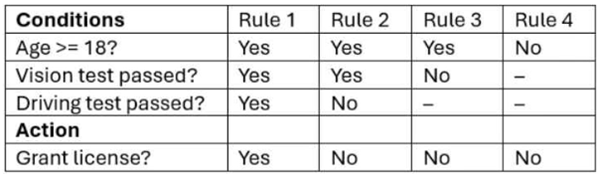
You have already designed three following test cases:
• 18 years old, passed both vision and driving tests; expected result: grant a license
• 17 years old, passed vision test, failed driving test; expected result: do not grant a license
• 19 years old, failed both vision and driving tests; expected result: do not grant a license
Which test case needs to be added to this set to achieve full decision table coverage?
A. No test case is needed; the existing test cases already achieve the required coverage
B. 17 years old, passed both vision and driving test; expected result: grant a license
C. 18 years old, passed vision test, failed driving test; expected result: do not grant a license
D. 20 years old failed vision test passed driving test-expected result: do not grant a license
Question #187 (Topic: Exam A)
You work on a project where the executed test set achieved 100% statement coverage.
What is the consequence of this fact?
What is the consequence of this fact?
A. Each executable statement with a defect had to be exercised at least once
B. The test set triggered no failures in the tested code
C. All requirements related to the code under test are met
D. Each decision outcome in the code had to be evaluated both for true and false
Question #188 (Topic: Exam A)
If:
• EC = number of exercised conditional branches in a code
• EU = number of exercised unconditional branches in a code
• С = number of conditional branches in a code
• U = number of unconditional branches in a code
Which metric correctly defines the branch coverage?
• EC = number of exercised conditional branches in a code
• EU = number of exercised unconditional branches in a code
• С = number of conditional branches in a code
• U = number of unconditional branches in a code
Which metric correctly defines the branch coverage?
A. ЕС/С + EU/U
B. (EC+EU) / (C+U)
C. EC/С
D. EC + EU
Question #189 (Topic: Exam A)
What is error guessing?
A. A test technique in which the tester anticipates the mistakes the developer might make, defects they might introduce, and failures that may occur due to these defects
B. A test technique in which a tester designs, implements, and executes tests to cover test conditions from a checklist built based on knowledge about how software fails
C. A test estimation technique in which testers use their knowledge and experience to estimate the effort needed to fix problems in the test process due to testers’ mistakes
D. A type of software testing that identifies vulnerabilities, threats, and risks in a system to ensure its resources are protected from unauthorized access and malicious attacks
Question #190 (Topic: Exam A)
Which of the following is TRUE about exploratory testing?
A. It is more effective when a tester is less experienced and has no domain knowledge
B. It uses test results to learn more about the test object and create more focused tests
C. It allows the use of experience-based test techniques but not black-box test techniques
D. It focuses not only on defect detection but also on defect avoidance through collaboration
Question #191 (Topic: Exam A)
Consider the following two versions of acceptance criteria for a user story: “As a registered user, I want to be able to change my user’s name to update my personal data”
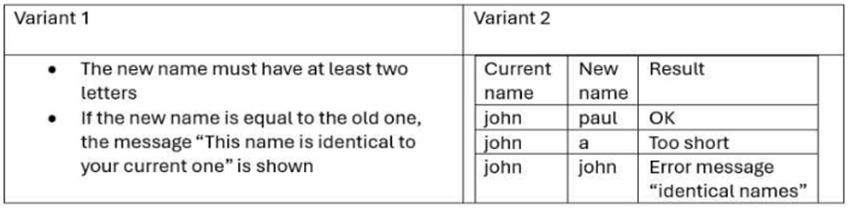
What is the format of the acceptance criteria in these variants?
What is the format of the acceptance criteria in these variants?
A. Both variants use a scenario-oriented format
B. Both variants use a rule-oriented format
C. Variant 1 is rule-oriented; Variant 2 is scenario-oriented
D. Variant 1 is scenario-oriented; Variant 2 is rule-oriented
Question #192 (Topic: Exam A)
Which TWO are the examples of entry criteria for system testing of a food order app? (Choose two.)
A. All functional tests for the payment process are automated
B. A test basis describing the business rules for discounts is available
C. All smoke tests of the registering and logging features passed
D. The appropriate functional tests cover all use cases
E. There are no critical and at most 3 major defects unresolved
Question #193 (Topic: Exam A)
Your team is developing a new functionality for an employee management system, a Simple Reporting feature. The team is tasked with estimating the test effort required to test this feature.
The team used the standard three-point estimation method to provide the predicted effort.
The team came up with the following estimates:
• in the optimistic scenario, the testing can be done in 1 hour
• in the most likely scenario, the testing can be done in 2 hours
• in the worst-case scenario, the testing can be done in 9 hours
What is the team's final estimation of the test effort?
A. 4 hours
B. 2 hours
C. 3 hours
D. 6 hours
Question #194 (Topic: Exam A)
You prioritize test cases using the additional coverage prioritization technique, using the requirements coverage as a coverage measure. All four test cases must be executed. The coverage achieved by your test cases is shown in the table below.
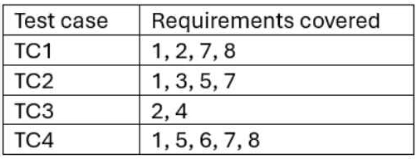
Which test case should be executed LAST?
Which test case should be executed LAST?
A. TC1
B. TC2
C. TC3
D. TC4
Question #195 (Topic: Exam A)
In the testing quadrants model, which testing is business-facing and supports the team?
A. Security testing
B. Component testing
C. API testing
D. Exploratory testing
Question #196 (Topic: Exam A)
What does the risk level depend on?
A. Risk impact and risk likelihood
B. Risk likelihood and risk priority
C. Risk impact and risk severity
D. Risk priority and risk severity
Question #197 (Topic: Exam A)
Categorize these risks into project risks and product risks.
(i) Unforeseen technical difficulties, such as integrating with third-party APIs for payment or delivery tracking, could slow down progress
(ii) Sensitive customer information, such as payment details and addresses, may be exposed due to insufficient security measures
(iii) Uncontrolled additional feature requests or unclear requirements may lead to delays and budget overruns
(iv) Limited availability of skilled developers, testers, or designers could hinder the timely delivery of the product
(v) Confusing navigation may lead to user dissatisfaction, causing a high churn rate
A. (i), (ii), and (iv) are product risks; (iii) and (v) are project risks
B. (ii) and (v) are product risks; (i), (iii), and (iv) are project risks
C. (iii) and (v) are product risks; (i), (ii), and (iv) are project risks
D. (iii) and (iv) are product risks; (i), (ii) and (v) are project risks
Question #198 (Topic: Exam A)
Which type of report will MOST LIKELY contain information about testing planned for the next period?
A. Test progress report
B. Defect report
C. Test completion report
D. Risk register
Question #199 (Topic: Exam A)
The customer reported the software failure in the form of a defect report, providing the version number of the software they use. Based on this information, the team identified the files used to build this version and the elements of the environment in which this version was created. This made it possible to identify and fix the defect quickly.
What process enabled the above actions?
What process enabled the above actions?
A. Defect management
B. Configuration management
C. Test automation
D. Test estimation
Question #200 (Topic: Exam A)
You prepared the following defect report.
Defect ID: DR-00123 Date: 2025-01-12
Title: “Order Confirmation” button not responsive after adding items to the cart
Severity: High Priority: Critical Reported By: John Doe
Steps to reproduce:
1. Launch the app and log in.
2. Browse the menu and add items to the cart.
3. Navigate to the cart and tap the “Order Confirmation” button.
Expected result: The “Order Confirmation” button should process the order and navigate to the confirmation screen.
Actual result: The “Order Confirmation” button is unresponsive, and no action is taken.
Attachments: Screenshot: [order_button_issue.png], Video: [order_button_issue.mp4]
Which of the following is the BEST way to improve this report to help developers resolve the reported problem?
A. Add expected results after each step in the “steps to reproduce” section
B. Add environment data and link to the test case that caused the failure
C. Reduce severity and priority levels
D. Add a suggestion how a source code could he chanced to fix the underlying defect